
Defence contracts: 47.2% went to Belgian operators
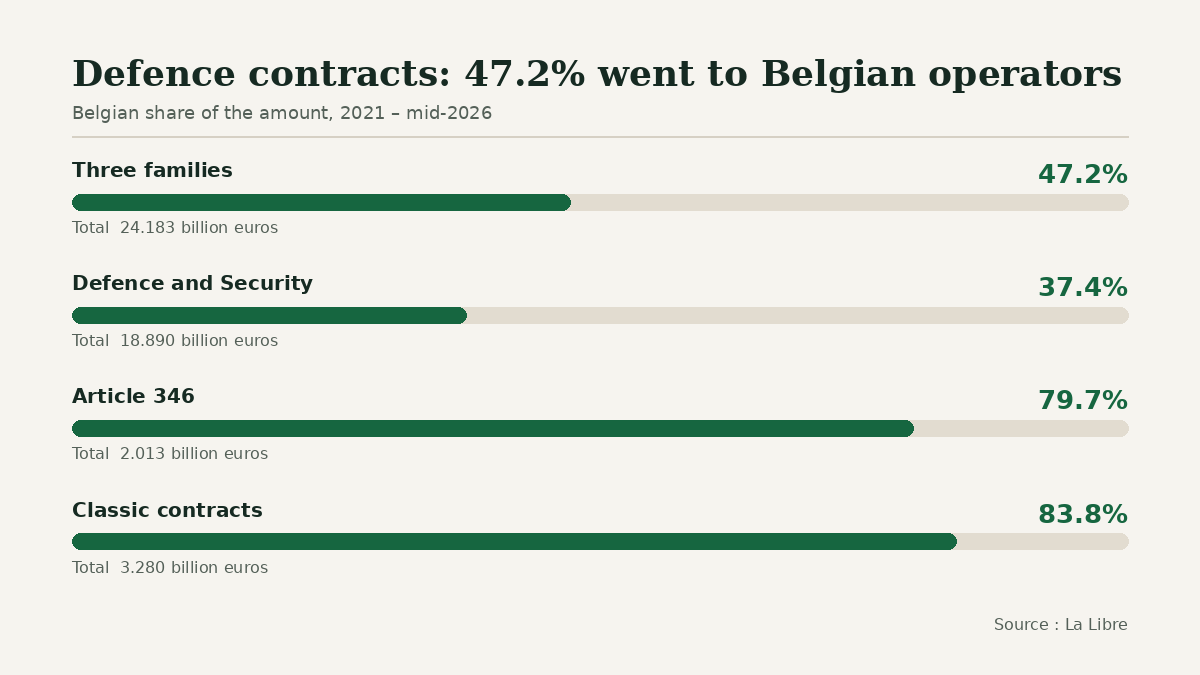
From 2021 to mid-2026, 11.416 billion euros out of 24.183, or 47.2%, of Belgian Defence investments through public contracts went to Belgian operators. Figures from minister Theo Francken to Parliament, published by La Libre on 21 October 2026. Salaries are not included. This share does not say who will win the next contract.
Updated
You learn what the Defence contract figures given in Parliament change for a Belgian company that wants to win one of those contracts.
Where these figures come from
On 21 October 2026, at 19:56 Brussels time, La Libre Belgique published the figures Defence minister Theo Francken (N-VA) gave in a parliamentary answer to MP Koen Van den Heuvel (CD&V). The article is by Antoine Clevers. It covers Belgian Defence investments made through public contracts between 2021 and mid-2026. Source: La Libre, 21 October 2026
The total is 24.183 billion euros. Of that total, 11.416 billion, or 47.2%, went to Belgian economic operators. Staff salaries and the running costs of infrastructure are not in these amounts. A company that wants to sell to Defence is reading a series of contracts, not the department’s payroll.
What this changes for a Belgian company
47.2% is the share of the amount already placed, between 2021 and mid-2026, with operators established in Belgium. An SME or a supplier that has not yet sold anything to Defence is not inside that percentage. The figure shows something else: companies in the country are already the holders of a large share of these contracts.
The rest of the amount has a holder elsewhere. For a company that wants to get in, the useful question is which kind of contract its product or its service can be asked for, and then which notices to watch.
La Libre writes that the opposition, except DéFI, regularly accuses the minister of steering military investment toward the US market at the expense of the Belgian and European markets, and that he denies it. The amounts on this page are those of the parliamentary answer, as La Libre published them.
Three kinds of contracts
The parliamentary answer covers three kinds of public contracts. You do not prepare the three in the same way.
The first is a military purchase under the Belgian public-procurement law on defence and security. It is mainly weapons, military vehicles and sensitive infrastructure. It is not the regime a municipality or a ministry uses for an ordinary purchase.
The second groups purchases that fall under essential security interests, the case Article 346 of the Treaty on the Functioning of the European Union names. The state may then take the purchase outside the usual European rules. Between 2021 and mid-2026, those purchases amount to 2.013 billion euros. 79.7% went to Belgian companies, or 1.605 billion. The rest went to France.
The third is the classic public contract, the kind that is valid for any administration. Supplies, services or works that are not placed in the two special regimes follow the common rules. Over 2021 to mid-2026, these contracts amount to 3.280 billion euros, of which 83.8% (2.750 billion) was spent in Belgium. For a company that already bids on ordinary public contracts, this is the most accessible entry point: the documents, the language and the place of submission read as they do on any other notice.
Why the Defence and Security share for Belgium is lower
In the Defence and Security family alone, from 2021 to mid-2026, the amount is 18.890 billion euros. Belgium received 7.061 billion of it, or 37.4%. That is less than over 2020–2025.
In the same family, the United States accounts for 17.1% (3.223 billion), Luxembourg for 15.5% (2.922 billion) and France for 15.4% (2.912 billion). Weapons, military vehicles, sensitive infrastructure: a large part of the recorded holders is outside Belgium. 37.4% in this family, 47.2% across the three families together: the Belgian share is higher as soon as you look past Defence and Security purchases alone.
37.4% for Defence and Security purchases from 2021 to mid-2026, 79.7% for Article 346, 83.8% for classic contracts.
In April the minister had already given figures for 2020–2025 on Defence and Security purchases. Belgium and its companies captured 47.3% of those purchases, far ahead of the United States (19%), France (5.6%) and the Netherlands (2.6%). That series covers 2020–2025. The series above, for the same family, covers 2021 to mid-2026. Each series is read for the years it names.
What a central purchasing body such as NSPA does
La Libre explains Luxembourg’s position by the presence there of NSPA, NATO’s Support and Procurement Agency. It is the Alliance’s central purchasing body. A contract placed through NSPA is counted in Luxembourg, where that body is established, and not in Belgium.
These percentages name the economic operator that is awarded the contract. A Belgian company that works as a subcontractor of a foreign holder, or of NSPA, does not thereby become the operator counted in the 37.4%. It can still take a part of the work: the supply, the service or the lot it knows how to deliver.
Where a company can get in
The most accessible entry point remains the classic contract, the kind that is valid for any administration. A company that already knows how to read a notice, gather the documents and submit a tender can start there, including when the buyer is Defence.
Belgian Defence notices are watched in two places. TED publishes the notices sent to the Official Journal of the European Union: TED e-Procurement, the Belgian platform, is at e-Procurement Belgian contracts that are not on TED are explained here: Markets not on TED
Before you answer a TED notice, check that it is still open: Still open Read the notice in a useful order: How to read a TED notice The place of submission and the language the notice publishes are here: Place of submission Where to submit a tender for a notice that is still open is in the guide Where to submit a bid The texts TED publishes on the documents to submit are here: Documents to submit
If the contract is for weapons, military vehicles or sensitive infrastructure, or if it is placed by a central purchasing body such as NSPA, an SME can aim at subcontracting rather than at the prime contract. It identifies the holder, or the company invited to submit a tender, and offers the part it can supply. AOEX does not find that holder for you, does not submit the tender and does not contact the buyer.
None of these figures says which company will be awarded the next notice. The text to follow remains the official notice and the procurement documents.
This note describes public documents and how AOEX works. It is not legal advice.
Edited by aoex.
